

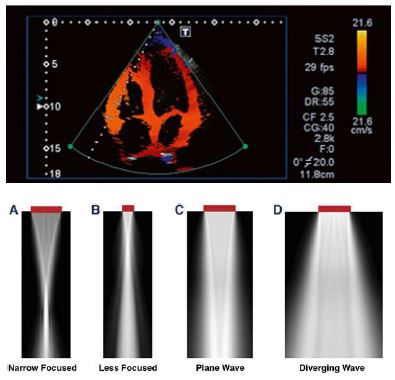
Tissue Doppler ultrasound imaging (TDI) enables the estimation of cardiac function by transmitting streams of pulses in a certain direction and estimating the velocity of the tissue from the phase shifts of the returning echoes. In order to estimate the velocity of the tissue precisely and separate slow tissue movement from dominant clutter, a large number of pulses has to be transmitted in the same direction. TDI has two main limitations: First, the number of transmitted pulses per unit of time is limited by the speed of sound in tissue and the desired imaging depth, therefore there is an inherent tradeoff between spectral and spatial resolution. This limitation impedes TDI usage to a few measurements through the LV wall. Second, in current systems the echoes detected by transducer elements are sampled at high rates of 3-4 times beyond their Nyquist rate, and processed to create a focused reception along a beam. A recent trend in ultrasound imaging is the transmission of unfocused beams (diverging waves) that enable the simultaneous scan of entire sectors. This shift in paradigm increases the frame rate significantly.Xampling and Compressed Sensing methods developed at SAMPL, allows the reconstruction of signals sampled at a sub-Nyquist rate with reduced number of pulses per velocity estimation, using priors on the sparsity of the signal. This reduced sapling is performed without compromising the same time temporal and spatial resolutions.In this project the implementation of the sub-Nyquist TDI demo system will be extended to include transmission of diverging waves. The system developed in this project will pave the way for quantitative cardiac imaging. In this project you will become familiar with Xampling and Compressed Sensing theory and Matlab simulations. In addition, you will gain experience in implementing signal processing algorithms on real ultrasound systems.